Wednesday, April 11, 2012

just for fun: Nikon's small world photomicrography competition

I was perusing on the good ol' internet when I stumbled upon this really neat competition that Nikon has every year.

Quick introduction (taken from the website http://www.nikonsmallworld.com/):
"Small World is regarded as the leading forum for showcasing the beauty and complexity of life as seen through the light microscope. For over 30 years, Nikon has rewarded the world's best photomicrographers who make critically important scientific contributions to life sciences, bio-research and materials science."

  
There are some really cool pictures. 
The winning picture (shown below) for 2011 was from Anna Franz. 
Ink injection into yolk sac artery of 72 hour-old chick embryo to visualize the beating heart and the vasculature (reflected light technique)
 

Tuesday, April 10, 2012

Technique: What is RNA interference?

The central dogma consists of
DNA --> mRNA (via transcription) --> protein (via translation)

RNA interference/RNAi is the silencing of RNA for controlling gene expression. This occurs naturally. Scientists have been able to use RNAi as a tool for studying gene expression, drug target screening, and for development of therapeutic drugs. 
  1. Double stranded RNA is cleaved into small interfering RNA/siRNA by the RNAseIII enzyme called Dicer.
  2. The siRNA are incorporated into silencing complexes that will target messenger RNA/mRNA for cleavage.
  3. The mRNA that is coding for a specific protein is degraded, and there won't be any protein expression.
Information was obtained from: http://www.vet.uga.edu/id/tripp/RNAi.php

http://www.vet.uga.edu/id/tripp/RNAi.php
This video was obtained from youtube. The original link for this video is: http://www.nature.com/nrg/multimedia/rnai/animation/index.html


http://www.nature.com/news/2009/090624/images/_tmp_articling-import-20090624083219872961_4591047a-i1.0.jpg


Richard Jorgensen is a molecular geneticist, who is an early pioneer in the study of RNAi. In the 1980s, he was asked to create purple petunias by a biotechnology company. He introduced the gene that coded for the color purple into the plant, and unexpectedly the petunias did not turn purple. A defense mechanism called RNAi was set off, and it deactivated all pigment genes in the plant.

This information was obtained from: http://www.oprah.com/health/RNAi-Based-Treatments-and-Possible-Cures-for-HIV-and-Cancer

Here is a link to the video from Nova: http://www.pbs.org/wgbh/nova/body/rnai.html

A few years after, another group of scientists also noticed this gene silencing effect in C. elegans. Andrew Fire and Craig Mello, were awarded the 2006 Nobel Prize in physiology or medicine for the discovery that RNAi is triggered by double stranded RNA (paraphrased from http://www.nigms.nih.gov/News/Extras/RNAi/factsheet.htm).

Saturday, April 7, 2012

Technique: Parabiosis

This past week in my developmental biology class, I learned about this really cool method called "parabiosis" that scientists use to study physiology.

Parabiosis is a method that joins two animals together physically and vascularly (they are exchanging blood). This model is analogous to making Siamese twins. It allows for scientists to learn a lot about physiology.  
Berntson, Gary G., and John T. Cacioppo. Handbook of Neuroscience for the Behavioral Sciences. Hoboken, NJ: Wiley, 2009. Print.

Parabiosis was used most famously to study leptin. 
Coleman, D.L. A historical perspective on leptin. (2010). Nature Medicine, 16, 1097-1099
historical perspective on leptin

Using the parabiosis model, Dr. Douglas Coleman was able to predict the presence of leptin and its receptor, 25 years before they were cloned. Here is a summary of his experiment. This was taken from the article (figure 2) mentioned above.
Leptin is a lipostatic signal that is produced by the ob gene, and its receptor is produced by the db gene.
  • In part A, a db/db animal is paired with a lean animal. The db/db animal is producing leptin, but not its receptor. From this we can conclude that the db/db animal is producing something (leptin) that is promoting a decreased in food intake and blood sugar. 
  • In part B, a db/db animal is paired with an ob/ob animal. The ob/ob animal has leptin receptors, but is not producing leptin. From this we can conclude that leptin from the db/db animal is promoting a decreased in food intake, insulinemia, and blood sugar. 
Remember that the animals are joined by their circulatory system.
  • In part C, an ob/ob animal is paired with a lean animal. The ob/ob animal has a decrease in food intake and blood sugar, while there isn't a change in the lean animal. The lean animal is able to make leptin.
  • In part D, two lean animals are paired together. There isn't a noticeable change in their physiology.
Dr. Coleman and Dr. Friedman (the guy who cloned the ob and db genes 25 years after Dr. Coleman's studies) won a Lasker award for their research about leptin and its receptor. 
http://www.jci.org/articles/view/45094

Dr. Douglas Coleman  (http://www.maineahead.com/vantage-point%E2%80%93doug-coleman/)


Dr. Jeffrey Friedman (http://www.nature.com/nm/journal/v10/n2/images/nm0204-116-I1.jpg)


Tuesday, April 19, 2011

just cool: diaster website

Here is a link to a website that tracks all of the disasters that are occurring globally right now:

http://hisz.rsoe.hu/alertmap/index2.php

Thursday, April 14, 2011

Technique: tips for pipetting

Precise pipetting is essential to all experiments, and it ensures that the data is precise.

For example, for loading SDS PAGE gel to examine how well you conducted your protein isolation, it is important there equal amounts of protein are loaded in order to examine the bands correctly. If one well has more sample than the others, then it will provide inconsistent, incorrect data.
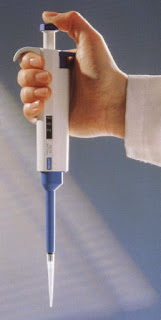
Image was obtained from Kind Saud University, http://faculty.ksu.edu.sa/moncef/Pages/OperatingtheMicropipette.aspx (accessed date 4/14/2011).
When pipetting:

1. Choose a pipette that has the maximum volume closet to the desired volume that you want to pipette out. 
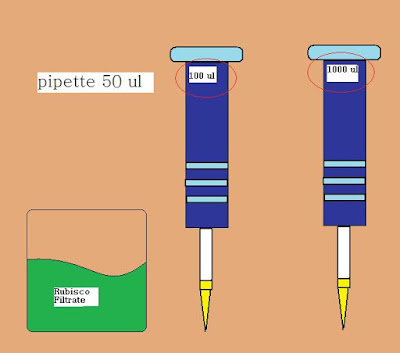
The 100 ul pipette should be used to pipette out 50 ul of Rubisco, because the maximum capacity of the pipette is closer to the desired amount of 50 ul. There is more precision with the 100 ul than there is with the 1000 ul pipette.

2. Set the correct volume on the pipette.
3. Hold the pipette vertical, the whole time when pipetting, so that no solution will enter the barrel and ruin the pipette.  
FYI = (A pipette costs ~ $400)  
http://www.eppendorfna.com/int/index.php?l=131&action=products&catalognode=9477&productpage=4
4. Slowly draw up the solution into the pipette.
5. When pipetting out a solution, press down until you feel the first stop, then when you want to release the solution, press all of the way down to the second stop. If you don't do this, then your volume isn't accurate, you may be pipetting too little or too much of the solution.


More tips:
- Pre-wet the pipette tip with the desired solution, before actually pipetting it out. By doing this, there won't be any solution stuck in the pipette tip, and it will ensure that an accurate volume was dispensed.
Oswald, N. 17 Ways to Stop Pipetting Errors Ruining Your Experiments. http://bitesizebio.com/articles/17-ways-to-stop-pipetting-errors-ruining-your-experiments/ (accessed date 4/14/2011).
- Store pipettes vertically to prevent any solutions from entering the barrel.
- After using the pipette return the pipette to its maximum volume to prevent messing with the calibration. For example, you are using a 100 ul pipette, and you want to pipette 50 ul, after pipetting that amount change the pipette volume back to 100 ul.

- If you are uncertain about how well you pipette, measure that volume on a balance (1 milliliter = 1 gram, then 1,000 ul = 1 gram).
To see how accurate your pipetting is measure the solution on a balance. Since 1,000 ul = 1 mL, then it equal 1.00 gram on the balance, because 1 mL = 1 gram.

Thursday, April 7, 2011

Technique: cartoon of how ammonium sulfate precipitation works

a cartoon about how ammonium sulfate precipitation works

This is a story about a boy, who doesn't have a lot of friends, so he plays by himself. 
Water molecules interact with each other via hydrogen bonding.


One day, he makes a new friend. They become best buddies.
Rubisco has some positive and negative charges that allows it to interact well with water; therefore, it is very soluble in water.
UC Davis Chemiwiki. Ribulose 1,5-bisphosphate carboxylase (rubisco). http://chemwiki.ucdavis.edu/Wikitexts/UCD_Chem_124A%3A_Berben/Ribulose_1,5-bisphosphate_carboxylase_%28rubisco%29/Rubisco_1 (accessed date 3/22/2011)
.


They are good friends, who sticks by each other.Until one day, the boy meets a girl. The girl takes the boy's attention away from his best friend. 

Ammonium sulfate has more appealing charges to water when compared to Rubsico.
chemexper. ammonium sulfate. http://www.chemexper.com/chemicals/supplier/cas/7783-20-2.html (accessed date 3/22/2011)

.


The girl (intentionally or unintentionally, the jury is still out) ruins a good friendship. The boy chooses her over his best friend, and his best friend is left out in the cold, ALONE.

Water interacts with ammonium sulfate more instead of with Rubisco; therefore, Rubsico falls out of solution with the extra help of the centrifuge.

Wednesday, April 6, 2011

the importance of protein isolation extends beyond the classroom

The purpose of this post is to share that researchers (REAL people, whose career focuses on isolating proteins) perform protein isolation.  There is meaning and purpose. 

Somewhere, right now a researcher is using a technique like ammonium sulfate. 

Here are some paper titles that is about isolating a protein (the protein varies) with author names, and universities that they are affiliated with:

(1) The P700-chlorophyll a-protein : Isolation and some characteristics of the complex in higher plants.   Judith A. Shiozawa, Randall S. Alberte and J. Philip Thornber 
Department of Biology and Molecular Biology Institute, University of California, Los Angeles, California

(2) Human placental anticoagulant protein: isolation and characterization
Takayuki Funakoshi, Ronald L. Heimark, Lee E. Hendrickson, Brad A. McMullen, Kazuo Fujikawa

(3) Fatty acid binding protein. Isolation from rat liver, characterization, and immunochemical quantification. R. K. Ockner, J. A. Manning and J. P. Kane  

(4) The retinal pigment epithelial membrane receptor for plasma retinol-binding protein. Isolation and cDNA cloning of the 63-kDa protein. 
C. O. Båvik, F. Lévy, U. Hellman,C. Wernstedt and U. Eriksson  
 
(5) PAIR Technology: Exon-Specific RNA-Binding Protein Isolation in Live Cells
Thomas J. Bell, Emelía Eiríksdóttir, Ülo Langel and James Eberwine

(6) Isolation of lipocalin-type protein from rainbow trout seminal plasma and its localisation in the reproductive system
Joanna Nynca, Mariola A. Dietrich, Barbara Bilińska, Małgorzata Kotula-Balak, Tomasz Kiełbasa, Halina Karol, and Andrzej Ciereszko 
Department of Gamete and Embryo Biology, Semen Biology Group, Institute of Animal Reproduction and Food Research, Tuwima 10, 10-747 Olsztyn, Poland.  Department of Endocrinology, Institute of Zoology, Jagiellonian University, 30-060 Krakow, Poland.